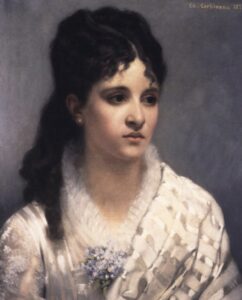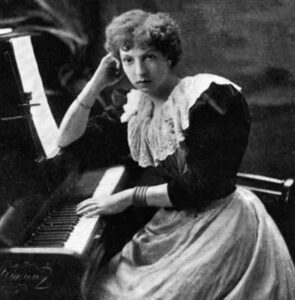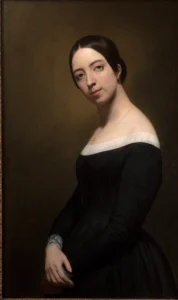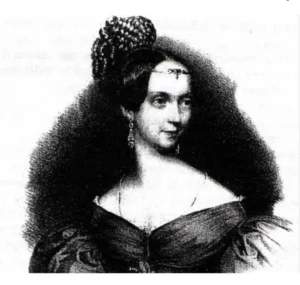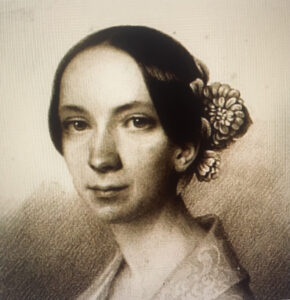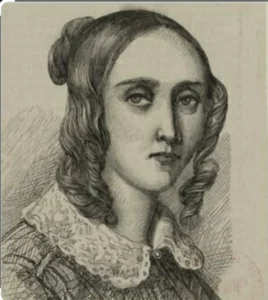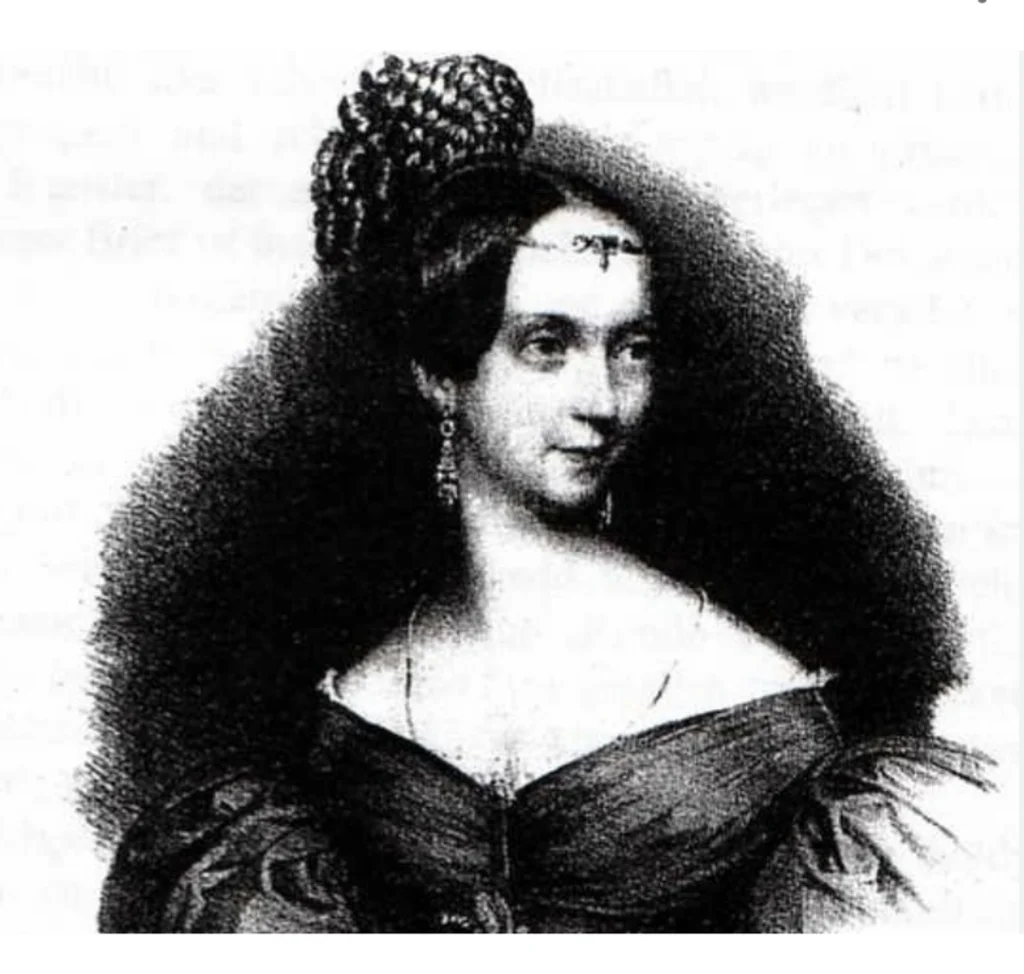
Born in 1813 in Magdeburg, Germany, Delphine von Schauroth was considered one of the most gifted pianists of her time. Making her debut at the age of nine in 1822, she toured Europe, astonishing audiences with her skill while inspiring rave reviews, poetic verses, portraits, and a plaster cast of her face for phrenologists to study the phenomenon of child prodigies.
It was said of the dazzling Liszt that, “He plays like Delphine!” rather than the other way around. Delphine was known for her improvisational skill and the emotional depth of her performance. Though few of her compositions survive, those that do reflect those qualities. Her surviving works include a collection of Songs Without Words, Op. 18, for piano, a caprice in B flat minor, and the powerful Sonata brillante.
When Felix Mendelssohn visited Munich in the summer of 1830, he attended a performance by Schauroth and the two developed a romance. They traded compositions, performed duets together, and Felix wrote to his sister Fanny that Delphine had composed a passage for his Symphony No. 1 in G minor that “rang out,” though he never publicly credited her for the addition.
Delphine’s mother had discouraged a formal engagement between her daughter and Felix, who left for Italy for a time. He dedicated the first of his Songs Without Words and the Symphony in G minor (which she had contributed to) to her, though he later married the amateur singer and artist Cecile Jeanrenaud.
Delphine married three times but ultimately separated each time, and had only one child who died at a young age. Because she was a baroness, and noblewoman were not encouraged to perform publicly or compose, it hindered her ability to pursue a career in music. Once she was a married woman her art was lost to the public, and with no family to carry her work forward, so too, to history.
What we do know of Delphine von Schauroth comes from the many reviews and announcements of her concerts and compositions during the 1820’s and 1830’s, as well as the letters, keepsakes, and communications of those artists and intellectuals with whom she mingled, including Josephine Lang, Felix and Fanny Mendelssohn, Franz Liszt, and Clara and Robert Schumann, the latter who wrote of Delphine that she was “an Amazon warrior in the kingdom of sounds.”
An epigraph taken from Tasso’s Gerusalemme conquistata and written on a lithograph of a young Delphine created by Langlume in Paris in approximately 1823 translates as, ‘The others fell silent to listen intently, and the winds stopped the whispers in the air.’
Few recordings of her works have been made. You can listen to her Sonate Brillante here: