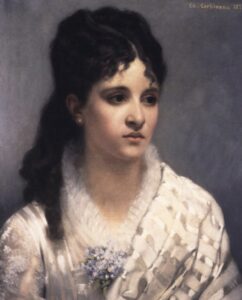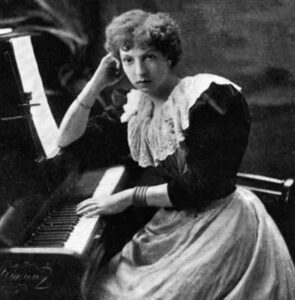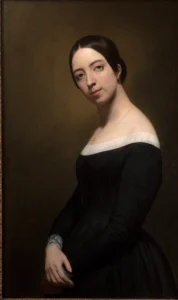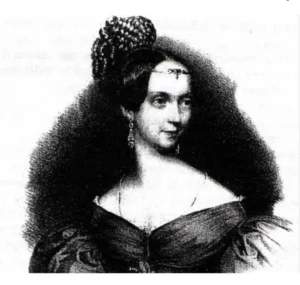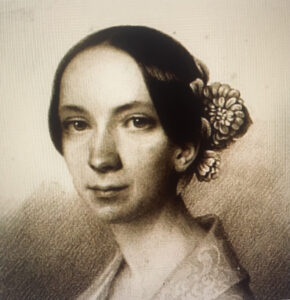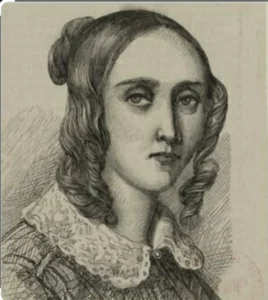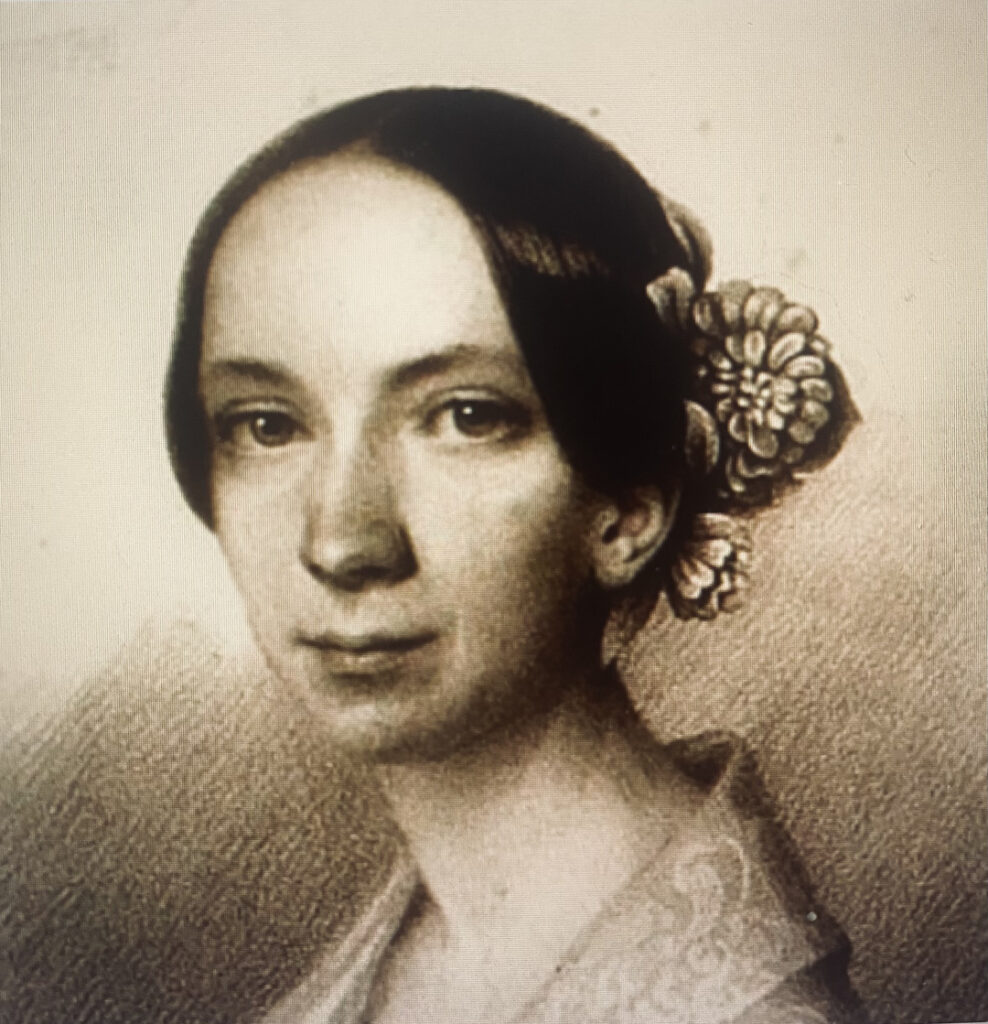
Emilie Mayer is unique among the composers featured in this project. She was not born, nor married, into a musical family. She was not an aristocrat. She did not study at a conservatory. Yet she became one of the most prolific and successful women composers of the nineteenth century, and enjoyed a fruitful career. Still, astonishingly, much of her music remains in its original handwritten form, unpublished, and unavailable to the public today.
Born in May of 1812, the third child and eldest daughter of five siblings, Emilie’s mother died when she was still a toddler. She began to study piano at the age of five, and her father, an apothecary, took delight in her abilities and encouraged her musical capacity. She was so creative in her interpretations of the pieces she learned that her teacher, the organist Carl Heinrich Ernst Driver, encouraged her to compose her own music.
Her father and siblings supported her in her pursuit of a musical career, but at the time, women were forbidden from formal study in composition. Tragically, in 1840, Emilie’s beloved father committed suicide on the anniversary of her mother’s death. A few months later, her longtime teacher also died. Bereft of the figures most important to her and deeply grieving, Emilie moved to Stettin (now in Poland), where her younger sister and brother-in-law had also relocated. There she took up private study with the composer and conductor Carl Loewe, and determined to make a career for herself in music.
Astounded by her ability, Loewe declared that “such a God-given talent as hers had not been bestowed upon any other person” (that he knew). Through him, she was able to share performances of her first orchestral works with the public, which included two symphonies. She also hosted private salon concerts, and was so successful that with Lowe’s encouragement she decided to further pursue her career in Berlin, and moved there on her own in 1847.
In Berlin, she studied with Wilhelm Wiepprecht and Adolf Bernhardt Marx, who encouraged Emilie in her compositions of orchestral pieces, declaring that “We must recognize the rights of women to an education with no limits towards them.”
Emilie continued to live alone and organized private concerts in her home. In the years that followed, her musical scores were distributed throughout Europe and she performed for the Imperial family in Vienna. Known as “the female Beethoven,” she was one of the most well-known composers in Berlin during her lifetime. Also an exceptional sculptress, many of her pieces continue to be in collections across Europe today.
Despite all that she accomplished, Emilie Mayer is little known today, and her eight symphonies, seven overtures, eight violin sonatas, twelve cello sonatas, seven string quartets, six piano trios, and her many smaller works, are rarely included in the canon of classical music.